
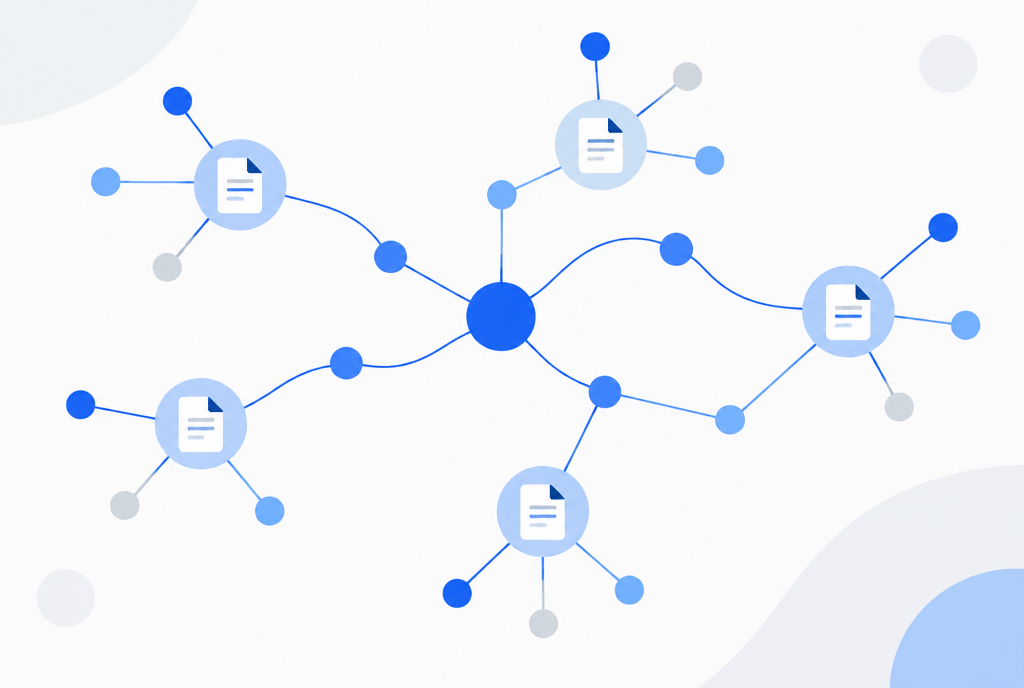
“Graph engineering” is an emerging, informal term, not an established discipline. Behind it sit real ideas: GraphRAG, which helps AI answer questions that connect many facts, and workflow graphs such as LangGraph, which structure how an AI agent works. Most small businesses do not need either to start. Plain search-based retrieval is usually cheaper and just as good for simple lookups.
Key takeaways
- “Graph engineering” is a new term. It appears in a July 2026 Analytics Vidhya blog post and an August 2026 arXiv paper, so treat it as emerging, not settled.
- GraphRAG is real and published. An independent study found it wins on multi-hop and time-based questions and loses on simple detail questions.
- LangGraph is a shipping framework for stateful, multi-step agents.
- “Context graph” is mostly vendor and investor language.
- Start with plain retrieval. Add graphs only when your questions need connected facts.
Is “graph engineering” a real thing?
Analytics Vidhya’s Harsh Mishra describes graph engineering as “the practice of representing an AI application as an executable graph”, where agents, tools, validators and humans are nodes. It includes validation gates and recovery paths. It is a reasonable idea. An August 2026 arXiv paper, “Graph Engineering in the Era of LLM Agents”, uses the same term for building explicit graphs of tasks, agents and system states. But the term is new and not yet a settled discipline. The pieces below are the established parts.
GraphRAG versus plain RAG
Standard retrieval-augmented generation, or RAG, finds text chunks that match a question and gives them to the model. It works well for questions with an answer in one place.
Microsoft Research developed GraphRAG for harder cases. A language model builds a knowledge graph from your documents, then groups it into communities with pre-written summaries used at query time. Microsoft says plain RAG “struggles to connect the dots” when an answer needs separate facts linked, and is poor at whole-dataset questions such as “what are the top themes”. Microsoft reports that GraphRAG outperforms baseline RAG on comprehensiveness and diversity. This is Microsoft’s own testing, with answers graded by a language model.
What independent testing found
Han and colleagues published an independent comparison as a preprint, “RAG vs. GraphRAG”. We checked the latest version, v3 from March 2026. The results are mixed.
- Plain RAG won on single-hop and detail questions. It also beat one GraphRAG mode on comprehensiveness.
- GraphRAG won on multi-hop and time-based questions. With Llama 3.1-70B on MultiHop-RAG, the local GraphRAG mode scored 71.17% overall against 65.77% for plain RAG. On temporal questions it scored 49.06% against 25.73%.
- GraphRAG had weaknesses. On two other datasets (HotpotQA and NQ), only about 65% of answer entities appeared in the built graph. In its global mode, Llama 3.1-70B correctly said “not enough information” on only 13.95% of such queries. Fine detail was lost in summaries.
- Combining both reached 77.62% on MultiHop-RAG by joining the evidence from each. That means running both systems.
These results come from academic datasets, not small business files. We found no study of GraphRAG in an SME setting.
Cost
Building the graph is the expensive step, because a language model summarises every entity and relationship. Microsoft’s LazyGraphRAG is a cheaper variant. Microsoft claims its indexing cost is “identical to vector RAG” and 0.1% of the cost of full GraphRAG. That is Microsoft’s own claim and has not been independently verified.
Workflow graphs and LangGraph
This is a different use of graphs. LangGraph is, in its own documentation, “a low-level orchestration framework and runtime” for long-running, stateful agents. You define nodes and edges. Some steps are fixed code and some are language model calls. It supports saving state, resuming after failure and pausing for a human to inspect or approve. The docs name Klarna, Uber and J.P. Morgan as users. That is the project’s own claim.
An example for a business is a quote workflow: draft the quote, wait for a person to approve, then raise the invoice. This is our suggested use. The LangGraph documentation supports the capability, but we have not found an SME case study.
Context graphs: mostly marketing
The term has two meanings. IBM describes a context graph as a form of knowledge graph that is “more dynamic and application-specific”, acting as a layer that selects what the model sees. IBM says this reduces hallucinations, but the page we read cites no study.
Foundation Capital, a venture firm, uses it for “a living record of decision traces” in an investment article from December 2025. It is an opinion piece with hypothetical examples and no empirical data. Neither source shows an engineering standard. Be sceptical when a vendor sells you a “context graph”.
When to use what
- Use plain RAG for FAQs, policy lookups and product questions where the answer sits in one document. It is cheaper and the independent study found it as good or better here.
- Consider GraphRAG when answers need linking facts across many documents, such as contracts, policies or emails. This is our suggestion. Test it against plain RAG first, and budget for the indexing cost.
- Use a workflow graph when a process has steps, approvals and recovery, and you want some steps to be fixed code rather than model judgement.
- Skip context graph products unless a vendor can show results on your data.
Whatever you choose, run both options on twenty real questions from your business before you commit.
If you are unsure which of these your business needs, talk to us. We will test the simple option first.
Sources
- Graph Engineering for AI Agents: Beyond the Single-Agent Loop, Analytics Vidhya, 28 July 2026
- GraphRAG: Unlocking LLM discovery on narrative private data, Microsoft Research, 13 February 2024
- RAG vs. GraphRAG: A Systematic Evaluation and Key Insights, Han et al., arXiv (preprint), submitted 17 February 2025, latest version v3 dated 4 March 2026
- LazyGraphRAG: Setting a new standard for quality and cost, Microsoft Research, 25 November 2024
- LangGraph overview, LangChain documentation, undated
- What is a context graph?, IBM Think, 6 May 2026
- AI’s trillion-dollar opportunity: Context graphs, Foundation Capital, 22 December 2025
- Graph Engineering in the Era of LLM Agents: From Individual Intelligence to System Intelligence, Feng et al., arXiv (preprint), submitted 21 August 2026